Web apps
React with Next.js, Vue.js with Nuxt, or Svelte, with server rendering where pages need to be found in search.
AI apps for web and mobile.
One backend underneath.
Web and mobile apps with AI built in, on a Go API that keeps model keys on the server, streams answers to the screen and enforces permissions and usage limits.
Every AI call goes through your API.
An AI app is mostly an app: sign-in, screens, permissions, analytics. The model is one dependency inside it, usually the slowest. We build the whole product, and every AI call goes through a Go API you own, so web and mobile share one set of rules for access, limits and cost.
React with Next.js, Vue.js with Nuxt, or Svelte, with server rendering where pages need to be found in search.
Mobile apps on the same API and accounts as your web product, with the same AI features and limits.
A Go backend that checks permissions and limits, streams answers and records what each AI request costs.
Seed to Series B teams in fintech, healthtech, social and marketplaces, e-commerce and logistics.
The app exists because a model does one job well, such as drafting a listing from a seller’s notes or answering questions over your own content. The app makes that step dependable, with clear states while it works and a fallback when it can’t.
Real users need accounts, roles, usage limits, analytics and often a mobile app. We keep what holds up and move model calls behind your API before launch. Still testing the idea itself? Start with AI MVP development.
The second client reuses the API, accounts and AI features you already have. The new work is mostly screens, plus what mobile adds: versioned API contracts for clients that update late, and states for weak signal. Need one AI feature in a product that already has users? AI integration is the faster route.
These layers decide whether an AI feature holds up on a weak connection, at peak traffic or in a provider outage.
Explore our full technology stack →The app sends an intent, such as “summarize this thread”, to your API, which checks permissions and limits, builds the prompt from a versioned template, calls the model and validates the response. Provider keys never ship in a mobile build or browser bundle, where they could be extracted, and a prompt change needs no app release.
Answers stream to the screen over a WebSocket gateway or a streaming HTTP response. Waiting, streaming, cut off, refused, rate-limited, timed out and offline each get a designed state. Retries carry an idempotency key, so a double tap or a quick reconnect attaches to the call already running, or picks up its stored result, instead of starting a second model call. A request that hits a provider’s timeout falls back to a second model or a cached response, and long jobs report progress from a queue.
Access to each AI feature is decided in the API, with the same role and tenant rules as the rest of the product; a prompt is never the access control. Per-user and per-plan limits sit in Redis beside rate limits, and every request is metered with its tokens and cost, which can feed billing through Stripe.
Events such as answer accepted, edited or discarded flow through Kafka to an analytics store, not your production database. Feature flags release an AI feature to one team first, compare prompts or models across cohorts, and switch it off at once if quality or cost drifts.
Underneath: stateless Go services on Kubernetes, PostgreSQL with pooling and read replicas, Redis for sessions and caching, and request queues with per-provider rate-limit handling. It is load-tested at your target concurrency against p99 latency budgets, with metrics, traces and alerts in the first release. Our Golang development services page covers each layer.
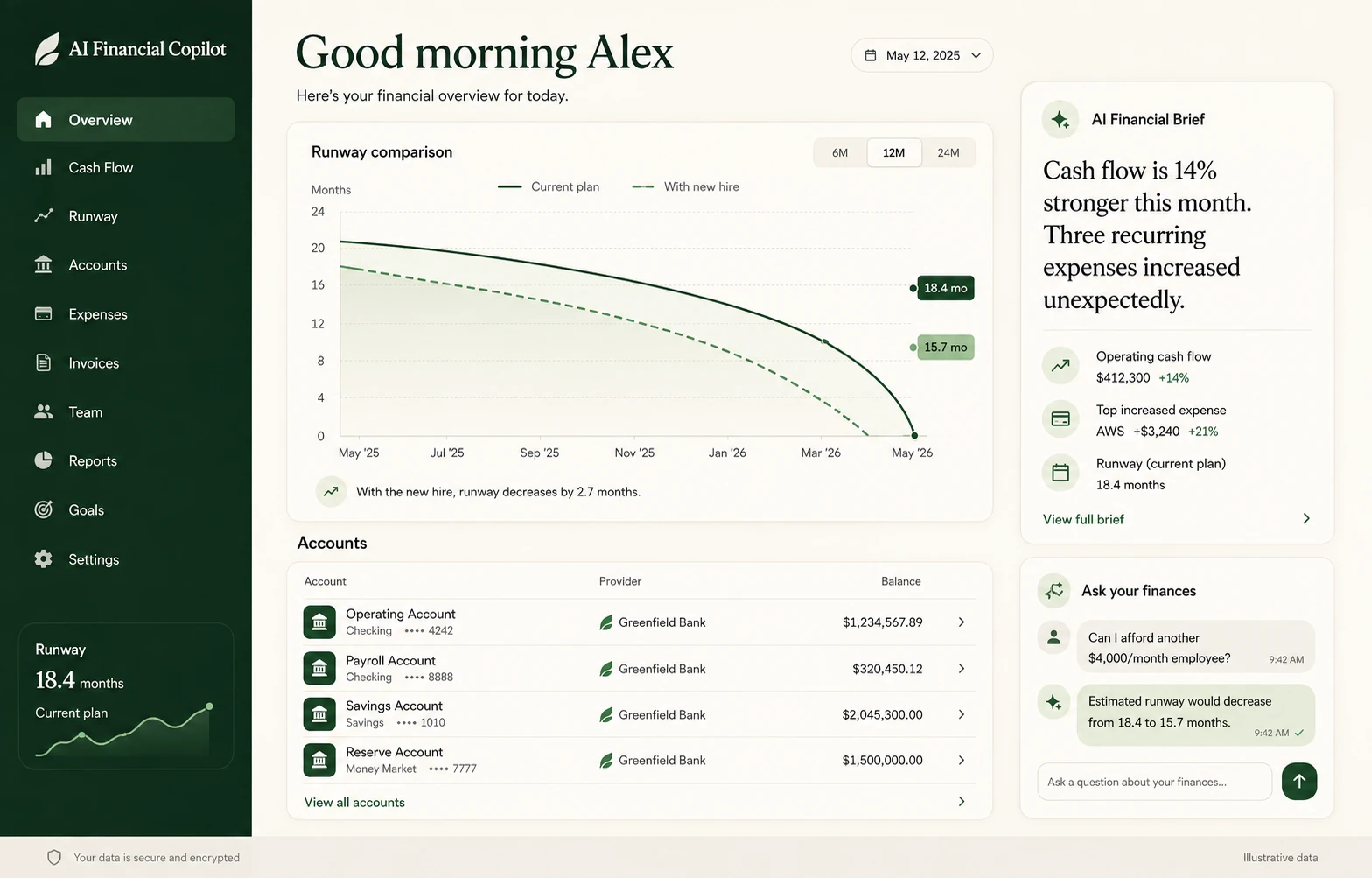
Explore the product interfaces featured in our portfolio. A useful AI app connects each screen to the data, workflows and systems underneath it.
Explore our work →Each part of the app is a fuse: a small module with a written contract and a harness that proves it works, built in parallel and wired in only when it passes.
See how we work →Every endpoint gets a short written contract before any code: request and response shapes, the streaming event format, error codes and a latency budget. Screens are built against a mock server that replays scripted responses, including slow streams, cut-off answers and rate-limit errors, so every state works before the real endpoint exists. API fuses pass contract tests and a load test, and AI endpoints an evaluation set as well.
Typical fuses are accounts, the assistant screen, document summary, usage limits, analytics and the feature-flag console. Nobody waits on another team, so adding engineers speeds the build up. A failure stays inside its fuse: if a model provider goes down, the AI feature shows its fallback and the rest of the app keeps working.
The timeboxes below are typical for AI app development; your scoped proposal confirms the range for your app.
On a free AI strategy call we talk through the app, who uses it and which AI feature has to work first. Then you get a free scoped proposal for the app: the screens and API work in scope, deliverables, acceptance criteria and explicit assumptions.
The Proof puts the app’s riskiest AI feature to the test first. Day 1 pins that feature to one use case and one number to move. Days 2–3 look at your data, existing screens and stack; days 4–6 pick the model approach that earns its cost; days 7–9 design the app for scale and security. Days 10–12 plan the build, with a roadmap and a cost per user. Day 14 is a working demo of that feature on your data, and a go/no-go.
Every week ends with a demo of working screens, wired to real endpoints as each one passes its harness. Web and mobile together, the number of AI features, integrations and compliance needs decide where you land in the range. For what moves a timeline, read how long it takes to build an AI MVP.
The API and web app go live in your cloud, with cost per request, latency and answer quality on dashboards from the first day. After launch you choose: Scale & Run, with the same senior team staying on month to month (cancel anytime), or a clean handover to the engineers you hire next, with documentation they can follow. Our engineers work Pacific Time hours from Silicon Valley for founders anywhere in the US; here is how that works for AI startups in the San Francisco Bay Area.
What founders usually ask before an AI app build. Bring anything else to the strategy call.
Yes. Web apps are built in React with Next.js, Vue.js with Nuxt, or Svelte, and mobile apps run on the same Go API and accounts. Permissions, usage limits and AI logic live on the server, so web and mobile behave the same and one fix reaches both.
Both start with the two-week AI Proof. An AI MVP, the smallest product that tests one core hypothesis, typically takes 6–10 weeks after it, with thirty days of support included. A fuller AI app, often web and mobile together with analytics, feature flags and usage limits, typically takes 8–14 weeks, confirmed in your scoped proposal.
Whichever fits each feature: Claude, OpenAI, Gemini or an open-source model, behind a model-agnostic layer, so switching provider is a configuration change and needs no app release. Each AI feature has its own test set for answer quality, speed and cost per request, and it runs again on every model change, so a switch is measured before users see it.
Every AI request is metered, and we watch tokens per task, context growth, retries and usage patterns. Per-user and per-plan limits, caching of repeated requests and a right-sized model per feature keep cost per request predictable. Cost per successful task sits beside quality and speed when deciding what ships.
Yes. For one or two AI features in a live product, AI integration adds them one at a time, typically 3–6 weeks per feature after the AI Proof. Work on an existing codebase starts with its architecture and conventions, and AI calls move behind your API.
You do. The code and IP are 100% yours from the first commit: repositories in your GitHub, the API and its data in your own cloud accounts, and a contract that spells this out in plain English. The model keys are yours too, we never train models on your data, and we sign your NDA and DPA.
Bring the users, the one AI feature that matters most and any data you already have. We’ll help you define a useful next step.
Most products combine a few capabilities. Explore the services that support the next part of your roadmap.